Renewable Power-to-X Basic Training in Bengaluru
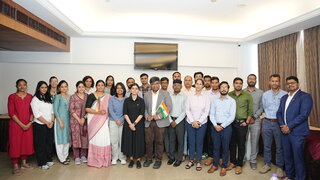
The Indo-German Energy Forum (IGEF-SO) and the International Power-to-X Hub jointly hosted the “Renewable Power-to-X (PtX) Basic Training on Green Hydrogen and its derivatives” from 18 to 20 November 2025 in Bengaluru, India. This course, facilitated by Mr. Vivek Jha, convened 25 participants from leading government bodies such as the Karnataka Renewable Energy Development (KREDL), Agency for New and Renewable Energy Research and Technology (ANERT) alongside a diverse group representing academia, research and think tanks, and sector associations.
The Renewable Power-to-X Basic Training provided a structured introduction to the PtX value chain and highlighted the role of renewable PtX in future energy systems and low‑carbon economies. In line with the PtX Hub training concept, the course covered PtX technologies, production processes, economics, and infrastructure, framed by the Environmental, Economic, Social and Governance (EESG) approach.
Following an opening introduction to Renewable PtX by the trainer, the course presented the PtX Hub’s philosophy and ongoing activities in India under the International Hydrogen Ramp up Program (H2Uppp) before moving into production pathways and key downstream products such as green ammonia and methanol. Participants discussed cost trajectories for electrolysers, green hydrogen, and PtX derivatives, and reflected on what these trends mean for emerging project pipelines in India.
A dedicated module focused on techno‑economic criteria of PtX infrastructure, including transportation, storage, and international trade of renewable PtX products. Participants explored sector‑specific demand markets and value chains, examining various application pathways and business cases relevant to India’s industrial, transport, and export sectors.
Another core part of the training was devoted to sustainability aspects of Renewable PtX, including the EESG Framework and the role of environmental and social safeguards, certification schemes, and sustainability standards. Discussions considered how robust sustainability criteria can support credible green hydrogen and PtX development in India and internationally.
The final module addressed policy and regulatory frameworks for Renewable PtX, covering support policies, regulatory requirements, and strategic considerations for scaling up PtX in India. In this context, India’s National Green Hydrogen Mission and related initiatives to position the country as a global hub for green hydrogen production, use, and export were highlighted and discussed.
On the last day, participants took part in a site visit and attended a presentation at Newtrace Pvt Ltd, one of India’s leading green hydrogen technology innovators. The visit included a guided tour of Newtrace’s laboratory and electrolyser testing facility, giving participants firsthand insight into the company’s research, development, and manufacturing processes. Newtrace has developed a proprietary, membrane-less electrolyser technology that enables the efficient production of high-purity green hydrogen. This practical exposure complemented the theoretical input sessions, deepening participants’ understanding of India’s emerging PtX sector and facilitating connections between sector stakeholders and technology developers.